
Institutional sanctions against the ICC escalate the unprecedented assault on international justice
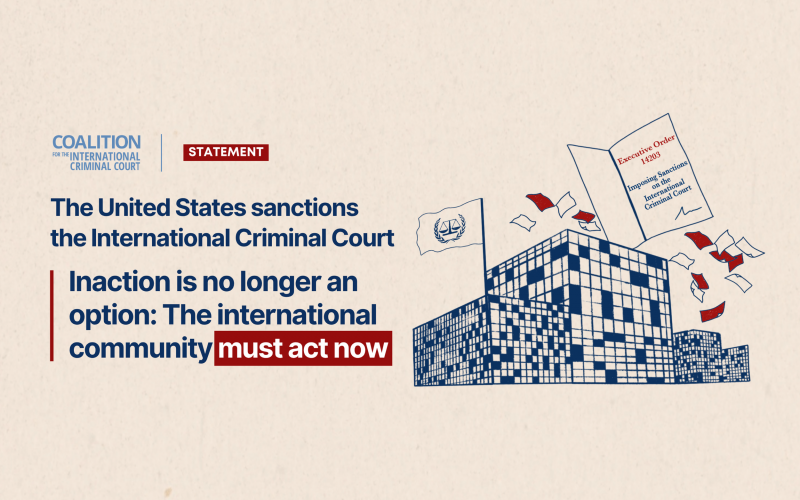
Today, the U.S. Administration has announced the designation of the International Criminal Court as an institution under Executive Order (E.O.) 14203, "Imposing Sanctions on the International Criminal Court."
“Sanctions are intended to make justice impossible by isolating the Court, disrupting its operations and deterring those who work with it. But their consequences reach far beyond an institution in The Hague: despite the resilience of those targeted, sanctions threaten access to justice for victims and survivors of the world’s most serious crimes. States Parties cannot allow coercive measures imposed by a non-State Party to determine whether victims can seek justice,” highlights Alison Smith, CICC Executive Director.
An escalating campaign against international justice
Institutional sanctions do not come in a vacuum: Since February 2025, the U.S. has progressively expanded sanctions against ICC officials and those working in support of the Court’s mandate. Judges, prosecutors and Court staff have been designated, alongside three Palestinian human rights organisations and a UN Special Rapporteur.
On 13 July 2026, the US State Department announced a new “whole-of-government response to systematically disable” the ICC’s ability to operate. The coercive measures listed in this new campaign include additional sanctions against the Court and affiliated organisations, visa revocations and diplomatic pressure to push state parties to withdraw from the Rome Statute and stop cooperating with the Court, including through threats to cut foreign and security assistance to States Parties. It is reported that both Chad and Venezuela’s withdrawals are linked to a US request to review its membership to the Court. The stated aim of such campaign, is to shield US nationals and allies, including Israel, from ICC investigation and prosecution.
Taken together, these developments threaten to normalise political and economic coercion against independent justice institutions and those who cooperate with them. They risk creating a system in which access to justice depends not on law, but on whether judicial institutions and those supporting them can withstand external political and financial pressure.
The impact of sanctions beyond the U.S.: A threat to justice and states’ sovereignty
Sanctions reach far beyond those formally targeted. As the Coalition documented in Criminalising Accountability: The US lawfare against the international justice system, measures directed at a limited number of individuals and organisations can produce a much wider chilling effect across the Rome Statute system, ultimately affecting victims and survivors seeking justice.
Institutional sanctions against the ICC magnify the risks and consequences identified in Criminalising Accountability to an entirely different level. They could disrupt the basic services and infrastructure on which the ICC depends, deter cooperation with the Court and further constrain the ability of victims and survivors to access justice and reparations.
The Court’s independence, and victims’ ability to seek justice before it, cannot depend on whether banks, technology companies, service providers and other private actors are willing or able to absorb the risks created by sanctions. States Parties must act collectively and decisively to ensure the Court can continue to function independently and that those seeking, delivering and supporting justice can do so without fear of intimidation, retaliation or sanctions, notably by immediately activating blocking legislations.
“In this context of unprecedented attack against the Court, the rule of law and victims, the European Commission should immediately activate the EU blocking statute and send a clear message that these unlawful sanctions will not be applied extra-territorially by EU service providers. Words of solidarity are not enough," states Zoé Paris, CICC Advocacy Coordinator.
Inaction is no longer an option: The international community must act
This moment requires more than expressions of concern: the 125 States Parties that created the ICC bear a collective responsibility to safeguard its independence and effective functioning and to protect the integrity of the Rome Statute system.
The Coalition therefore calls on States Parties and regional organisations to:
-
Publicly and unequivocally condemn the sanctions against the ICC and those cooperating with it and demand their immediate revocation.
-
Immediately activate and enforce blocking measures, including the EU Blocking Statute and equivalent national legislation, to shield the Court, its staff, assets and partners from the extraterritorial effects of U.S. sanctions.
-
Guarantee continued access to essential services, including banking, payments, insurance, IT and digital services, and take the necessary legal and regulatory measures to prevent over-compliance and de-risking by service providers.
-
Provide clear legal guidance to banks and service providers that U.S. sanctions should not be applied extraterritorially where no U.S. nexus exists, and secure resilient non-U.S. alternatives where necessary.
-
Fully uphold all Rome Statute obligations, including funding the Court and the Trust Fund for Victims, cooperating with investigations, and executing arrest and surrender requests without exception, delay or selectivity.
-
Reject all political and economic coercion aimed at influencing the Court or the Rome Statute system, including attempts to shape votes at the ICC’s Assembly of States Parties, including judicial elections in 2026; prosecutorial priorities; cooperation decisions; or the Court’s jurisdiction.
-
Build collective and long-term resilience, including alternative financial and digital infrastructure, coordinated protection for sanctioned individuals and organisations, and legal, diplomatic and financial support for all those targeted because of their work for justice.
-
Find concrete measures to mitigate the impact of sanctions on civil society organisations, including the loss of funding, and ensure, through concrete measures, that civil society organisations are not chilled or limited in their freedom of speech and association due to the sanctions.
