
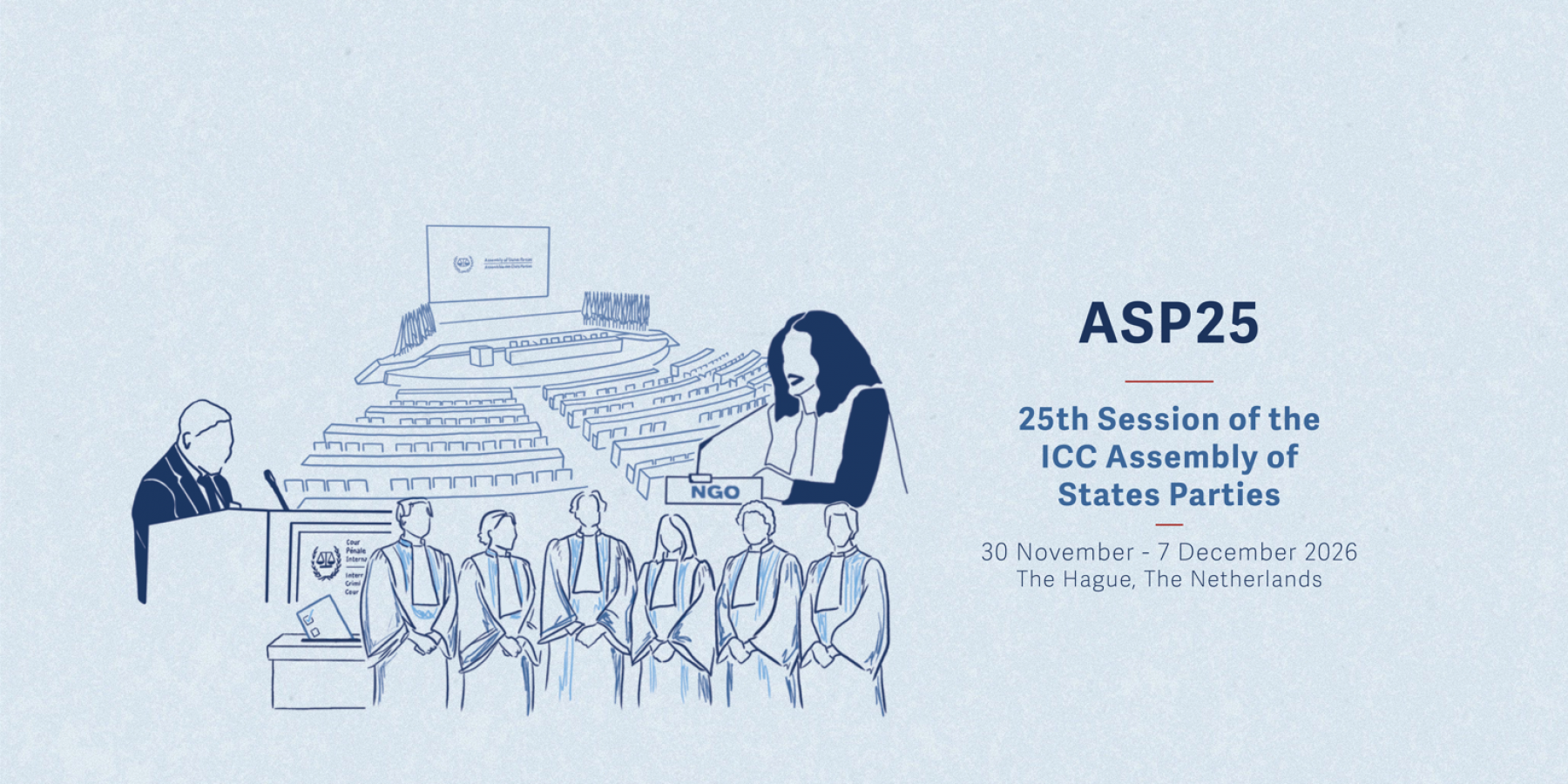
25th session of the ICC Assembly of States Parties, 30 November - 7 December 2026 (ASP25)
From 30 November to 7 December 2026, States Parties to the Rome Statute will gather in The Hague for the 25th session of the ICC Assembly of States Parties (ASP25).
The Assembly is the management oversight and legislative body of the Court. Meeting in full plenary once a year, States Parties take decisions that are critical to the effective functioning of the Court and the broader Rome Statute system.
ASP25 takes place at a critical moment for international justice. As attacks against the ICC, its officials, civil society organisations and others supporting its mandate have intensified, the Assembly provides States Parties with an essential opportunity to demonstrate, through concrete action, their commitment to an independent and effective Court and to protect the integrity of the Rome Statute system.
Civil society will be present throughout the session, monitoring discussions, engaging with States Parties and Court officials, advocating for a fair, effective, and independent ICC, while ensuring that the perspectives of victims, survivors, and human rights defenders remain at the heart of deliberations on justice and accountability.
States Parties must turn support for international justice into concrete action
ASP25 takes place at a defining moment for the International Criminal Court and the Rome Statute system.
At this year's session, States Parties must demonstrate through coordinated and concrete action that threats, sanctions and other forms of coercion will not be allowed to compromise the independence of the Court, weaken cooperation with it, or determine who can participate in the Rome Statute system. Upholding the ICC’s mandate requires more than rhetorical support, it calls for sustained political will, collective action, and meaningful cooperation. This includes:
-
Publicly reaffirming strong support for the ICC’s independence and the integrity of the Rome Statute system;
-
Ensuring effective cooperation with the Court, including on arrest warrants and evidence sharing;
-
Defending the Court, its officials, and partners from political interference, threats, or sanctions, including by finding concrete solutions to the current sanctions;
-
Providing the necessary political, financial, and diplomatic support for the ICC to carry out its growing workload;
-
Electing elect highly qualified judges of high moral character. At ASP25, States should also establish a sound framework for the next Prosecutor’s election, with rigorous due diligence, transparent procedures and meaningful civil society engagement; and
-
Fostering an enabling environment for civil society and human rights defenders who advance justice for victims, including civil society organisations targeted by sanctions, or at risk of being sanctioned.
Justice for victims, and the integrity of the international rule of law, depend on it.

Wanted: Highly qualified candidates to become ICC judges
At its twenty-fifth session, the Assembly of States Parties to the Rome Statute (ASP) will elect six judges to fill one-third of the International Criminal Court’s 18 judicial seats, following the regular three-year election cycle. The six newly elected judges will each serve for a nine-year term from 2027 to 2036.
Judicial elections are among the most significant governance functions of the Assembly. The quality, independence, and diversity of the Court’s bench directly shape the ICC’s credibility, jurisprudential development, and operational performance. The Rome Statute establishes a detailed legal framework designed to ensure that judges are selected based on merit, integrity, and representativeness, while subsequent Assembly resolutions have progressively strengthened transparency and due diligence safeguards.
#NGOVoices at ASP25
Ahead of ASP25, civil society organisations and human rights defenders from every region share their priorities and recommendations for strengthening justice through the ICC and the Rome Statute system.
These contributions are more than statements: they reflect the lived realities of those on the frontlines of accountability efforts. Throughout ASP25, #NGOVoices will continue to spotlight these perspectives, ensuring that decisions taken in The Hague reflect the needs and insights of those working for justice around the world

Side Events: Broadening the scope of ASP25 discussions
In the margins of ASP25, civil society, States and the Court and other actors organise multiple side events.
Side events represent a unique opportunity to raise #NGOVoices around specific topics of mutual concern, including situations under investigation or preliminary examination, victims’ participation in confirmation of charges hearings, judicial and political developments related to the ICC and the ASP, threats and attacks against the international justice system, and other issues related to the ICC and the Rome Statute system.
