
International Justice Day 2026: Keeping the flame of justice alive
Twenty-eight years ago, States gathered in Rome adopted a revolutionary vision for international justice: that those responsible for genocide, crimes against humanity, war crimes, and the crime of aggression should be held accountable, and that victims of the world's gravest crimes should have their right to justice be realised.
On this International Justice Day, the Coalition for the ICC (CICC or Coalition) commemorates the adoption of the Rome Statute and reaffirms its commitment to its enduring promise. We celebrate the progress that has been made in the fight against impunity, acknowledge the challenges that remain, and renew our determination for justice and the protection of the Court.
International justice under pressure
The vision established in Rome remains as critically necessary today as it was in 1998. Yet the institutions and individuals working to advance international justice face mounting challenges and attacks.
Over the past year, the ICC and civil society supporting its mandate have continued to face political pressure, unlawful sanctions, and efforts to undermine victims’ access to justice. Across many regions of the world, civic space continues to shrink, while human rights defenders and civil society organisations encounter intimidation, harassment, and reprisals for documenting crimes, supporting victims, and advocating for accountability.
Under Executive Order 14203, the US administration has sanctioned the ICC Prosecutor, the two ICC Deputy Prosecutors, eight ICC judges, the UN Special Rapporteur on the occupied Palestinian territories, and Palestinian civil society organisations. Further, the Moscow City Court convicted nine ICC judges and prosecutors in absentia in retaliation for the issuance of ICC arrest warrants against several Russian nationals, including President Vladimir Putin. Beyond those targeted, the invisible impact of these coercive measures, targeting a few but impacting many through a chilling effect, affects the Rome Statute system as a whole, and ultimately, victims. These escalations could have a long-lasting impact on international justice, victims and survivors of mass atrocities from across the world.
Furthermore, the persistence of non-cooperation continues to threaten the effectiveness of the Rome Statute system. The failure of States Parties to fulfil their obligations undermines not only the authority of the Court, but also the rights of victims who depend on it. In January 2025, the Italian police arrested Osama Elmasry Njeem, the former head of the Libyan Judicial Police in Libya, following an arrest warrant from the Court for alleged crimes against humanity and war crimes. However, Italy failed to discharge its obligation to transfer him to the Hague and, instead, sent him back to Libya. In April 2025, Israeli Prime Minister Benjamin Netanyahu, for whom the Court issued an arrest warrant in November 2024, visited Hungary, a signatory of the Rome Statute from which cooperation obligations on the arrest and surrender of individuals subject to arrest warrant derives. However, Hungary’s Prime Minister never responded to the Court’s request for transfer but submitted a bill before Hungary’s National Assembly authorising it to withdraw from the Statute. In October 2025, Russian President Vladimir Putin, who is subject to an ICC arrest warrant, travelled to Tajikistan, a State Party to the Rome Statute, without being arrested and surrendered to the Court. Such failures to execute arrest warrants weaken the collective commitment to accountability, undermine confidence in the international justice system, and deny victims the meaningful prospect of justice.
Additionally, Burkina Faso, Mali and Niger have recently submitted withdrawal letters from the Rome Statute to the Court, ultimately weakening efforts to end impunity.
These developments remind us that international justice cannot be taken for granted. The institutions created to uphold accountability are only as strong as the collective commitment to defend and support them.
The pursuit of justice continues
Jamil Dakwar, Director of the Human Rights Program, American Civil Liberties Union (ACLU) when discussing the US sanctions: “We will continue to reject this abuse of power.”
Yet despite these challenges, the pursuit of accountability continues.
Victims, survivors, human rights defenders, civil society organisations and the ICC itself have refused to abandon the promise of Rome. Across the globe, communities affected by atrocities continue to demand truth, justice and reparations. They continue to document crimes, preserve evidence, support survivors, and advocate for accountability, often at considerable personal risk.
Judge Alapini-Gansou, one of the ICC judges sanctioned by the US for her work at the Court, highlights how: “These measures have no effect on our dedication to our work because we are assigned to this task and we must answer for it. The victims around the world are waiting for us and watching us.”
Hope is not naive optimism: it is the determination of survivors who continue to seek justice decades after crimes were committed. It is the persistence of families who refuse to allow loved ones to be forgotten. It is the courage of civil society organisations that continue their work despite threats, intimidation and shrinking civic space. It is the conviction that accountability remains possible, even when progress appears slow.
Father Albert, Member of Network Against Killings in the Philippines and Board Member of No Peace Without Justice comments: "People ask me: You are a priest, why join an international coalition to fight the perpetrators of extrajudicial killings who have blood in their hands? Why not just forgive and move on? Pope Francis rejects that kind of forgiveness that only silences the victims under the guise of Christian charity and allows the criminals to keep on trampling people's dignity with impunity. Loving the oppressors requires stripping them of the power that destroys themselves and others. Those who suffer injustice must vigorously defend their dignity. 'Forgiveness does not prevent us from working for justice; it actually demands it.’"
Breakthroughs on the path to accountability
Since we last commemorated International Justice Day, we have witnessed important advances in the pursuit of justice for victims and survivors across multiple situations before the Court.
In July 2025, the ICC delivered its judgment in the case against Alfred Yekatom and Patrice-Edouard Ngaïssona, convicting both of the accused of war crimes and crimes against humanity committed in the Central African Republic (CAR). For victims who have waited more than a decade to see accountability for atrocities committed during the conflict in CAR, the judgment represented an important affirmation that justice remains possible. The Central African Coalition for the CICC (CCCPI) stresses that “International justice, particularly through the ICC, has played an essential role in the quest for truth, accountability, and reparations for victims”.
Further, in the case of Darfur, the Court delivered its judgment in the case against Ali Muhammad Ali Abd-Al-Rahman, known as Ali Kushayb, in October 2025, marking the first conviction arising from the United Nations Security Council's referral of the situation in Darfur twenty years earlier. “Justice may arrive late, but for Darfur’s victims, it still matters. This verdict is a long-awaited step toward accountability and a reminder that impunity is not permanent”, highlights the Darfur Network for Human Rights.
In April 2026, Pre-Trial Chamber I of the ICC confirmed charges against former Philippine President Rodrigo Duterte for crimes against humanity allegedly committed in the context of the so-called "war on drugs". “For the families of victims, many of whom continue to live in fear and struggle against fading hope, these decisions affirm that avenues for justice remain open. They offer a path toward truth and justice in the face of years of disinformation and stigmatisation that have normalized and justified unlawful killings,” highlights the Philippine Coalition for the ICC (PCICC).
In the case of Libya, the May 2026 confirmation of charges hearing against Khaled Mohamed Ali El Hishri mark a significant milestone in the ICC's engagement in the situation. For many victims and affected communities, “at a minimum, it signals that their years of seeking truth and accountability have not been in vain,” underscores Ali Omar from Libya Crimes Watch. “For many victims and affected communities, not only in Mitiga but across Libya, this development affirms that their testimonies, documentation efforts, and continued advocacy are beginning to translate into concrete steps toward justice.”
Additionally, at a time when concerns regarding withdrawals, disengagement, and attacks on international justice persist, the decision of Hungary in May 2026 to withdraw its notification of withdrawal from the Rome Statute and remain a State Party sends an important signal of continued support for the international justice project.
NGO Voices as the driving force behind the fight against impunity
Raji Sourani, director of US-sanctioned Palestinian Centre for Human Rights: “PCHR has 65 staff, including 38 still living in Gaza. Every person working at PCHR is part of the society, they were subjected to displacement, lost their homes, suffered from famine, lack of water and medicine. All our staff lost loved ones, some up to dozens of their extended family members. At PCHR, we lost three staff members, including two lawyers and my assistant who were killed with their families. Despite this heavy price, our staff continue to work for justice and accountability. We are part of the people; we have nothing special except our commitment to defend victims, to expose the reality and to seek accountability for the victims.”
The positive developments we have witnessed are the result of years, and often decades, of determined work by victims, survivors, human rights defenders and civil society organisations around the world. They document crimes, support affected communities, preserve evidence, engage with judicial institutions, and ensure that the voices of victims remain at the centre of international justice processes.
Across the world, human rights defenders continue to face threats, harassment, and reprisals simply for standing with victims and cooperating with international justice mechanisms. Yet despite these risks, they remain steadfast in their commitment to ending impunity and advancing accountability.
The Coalition for the ICC was founded on the belief that civil society has a critical role to play in building and strengthening the Rome Statute system. Today, that belief remains as relevant as ever. Every accountability milestone achieved over the past year stands as a testament to the persistence, courage and leadership of civil society.
Alison Smith, Executive Director of the Coalition for the International Criminal Court explains how: “Every attempt to silence civil society reminds us why this work remains necessary. Human rights defenders, victims' groups, survivor advocates and civil society organisations continue to stand alongside those seeking justice because accountability matters. Their resilience demonstrates that despite powerful forces opposing accountability, demands for justice continue to grow, and so does our collective commitment to pursue it.”
Renewing the promise of Rome: A call to action
Christy Fujio, Executive Director, Synergy for Justice: "The promise of the Rome Statute was never simply to establish an international court, it was to ensure that no one is beyond the reach of justice. Twenty-eight years later, that promise can only be realised if States fulfil their legal obligations and if survivors and civil society organisations are recognised and supported in the indispensable role they play in documenting crimes, preserving evidence, and advancing accountability. Renewing the promise of Rome means recognising that justice is not delivered by institutions alone: it is built through the courage of survivors, the persistence of civil society, and the collective commitment of States to uphold the rule of law."
Twenty-eight years after the adoption of the Rome Statute, the pursuit of justice continues. The promise of Rome endures, but it depends on States honouring their commitments under the Rome Statute and standing with victims, survivors, and those who risk so much in pursuit of accountability.
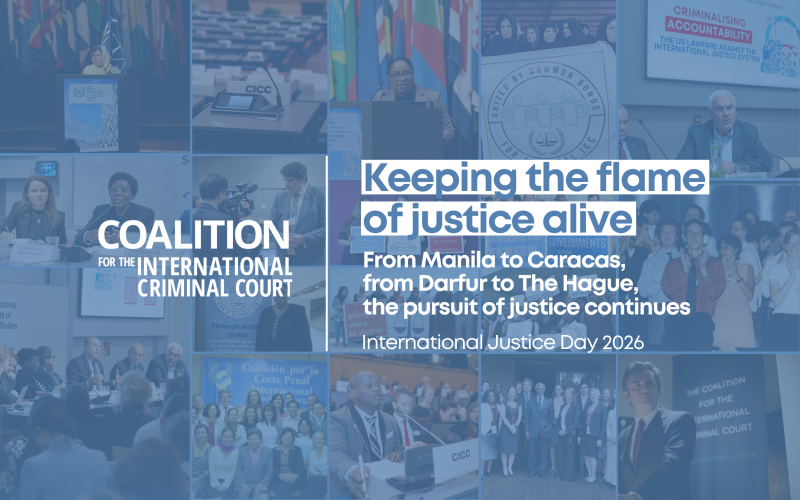
From Manila to Caracas, from Darfur to The Hague, victims and survivors continue to demand accountability, and civil society continues to stand beside them. Yet, access to justice demands action, and the Coalition for the International Criminal Court calls on States Parties to renew their commitment to the Rome Statute system by:
- Protecting and supporting human rights defenders, civil society organisations, and survivors working to end impunity and support the ICC. As threats and reprisals intensify against those committed to justice, especially for their work with the ICC, their protection must be a priority. Protecting those who pursue justice against threats, sanctions, and lawsuits is inseparable from protecting victims and survivors themselves.
- Defending the Court’s independence: Publicly condemn and reject any measures, threats or attacks on the Court and its independence. Reaffirm an unwavering commitment to the ICC’s independence and mandate, ensuring it remains free from intimidation and external pressure and provide concrete protection measures to support its resilience, including through the immediate activation of the EU Blocking Statute and similar national and regional blocking legislation.
- Cooperating fully with the ICC, including through the systematic execution of arrest warrants, responses to requests for cooperation, the conclusion of voluntary cooperation agreements and the ratification of the Agreement on Privileges and Immunities of the ICC (APIC).
- Ensuring that the Court has the political backing and sustainable resources necessary to fulfil its mandate across all situations under its jurisdiction.
- Increasing contributions to the Trust Fund for Victims (TFV) to ensure that the TFV can fulfil its mandate and address harms resulting from ICC crimes.
The flame ignited in Rome 28 years ago continues to burn through the efforts of victims, survivors, civil society organisations, and all those who refuse to abandon the pursuit of accountability.
The work continues and the Coalition stands with every advocate, every survivor, and every community determined to see justice done. Together, we move closer to a world in which no one is above the law, no victim and survivor is forgotten, and justice remains within reach for all.
